House Leveling & Piering in Annandale, VA
Push pier and helical pier installation to permanently stabilize settled foundations in Fairfax County — lifetime manufacturer warranty, written pier plan before any commitment.
Call Now: (571) 620-3358Foundation settlement in Annandale and Fairfax County is one of the most common structural maintenance issues in Northern Virginia's mid-century housing stock. The region's Piedmont clay soil — dense, expansive, and up to 15 feet deep in its active zone — creates persistent seasonal movement that slowly drops perimeter footings over decades. Annandale VA Foundation Pros installs push pier and helical pier systems that drive through the active clay layer to stable bearing strata below, permanently transferring the foundation load and allowing hydraulic lift of the settled portions. Call (571) 620-3358 for a free inspection and written pier plan.
Why Northern Virginia Foundations Settle
Fairfax County's Piedmont soils are weathered from ancient metamorphic and igneous rock, producing clay-rich profiles that the USDA classifies in the Herndon, Dulles, and Occoquan series. The clay component shrinks measurably during Northern Virginia's summer dry period — July through September in a typical year — and expands after fall rains and winter snowmelt. The active zone extends 8–12 feet below grade in most Annandale-area soils.
The postwar housing stock built on this soil between 1945 and 1975 used shallow foundation systems engineered to 30-year mortgage standards. After 50–75 years of clay cycling, original footings that sat at the top of the active zone have experienced hundreds of contraction-expansion cycles, each one potentially leaving the foundation slightly lower than it started. The accumulated settlement from decades of Piedmont clay movement is what push piers correct — not the seasonal variation, but the net downward drift.
Project Details
| Service | Push Pier / Helical Pier Foundation Stabilization |
|---|---|
| Installation Timeline | 1–3 days depending on pier count; most Annandale residential jobs 2 days |
| Primary System | Steel push piers (Earth Contact Products or Chance/Hubbell) for standard residential loads |
| Helical Piers | Used for lighter loads, interior applications, or where push pier driving force is insufficient |
| Lift Method | Simultaneous hydraulic lift — all piers raised at equal rate to minimize cracking stress |
| Pier Warranty | Lifetime manufacturer warranty on hardware; transferable to subsequent owners |
| Drainage Recommendation | Included in every assessment — pier installation without drainage correction addresses the symptom but not the cause |
| Pricing | Quoted per job after free on-site inspection — every quote is itemized in writing |
Our Piering Process
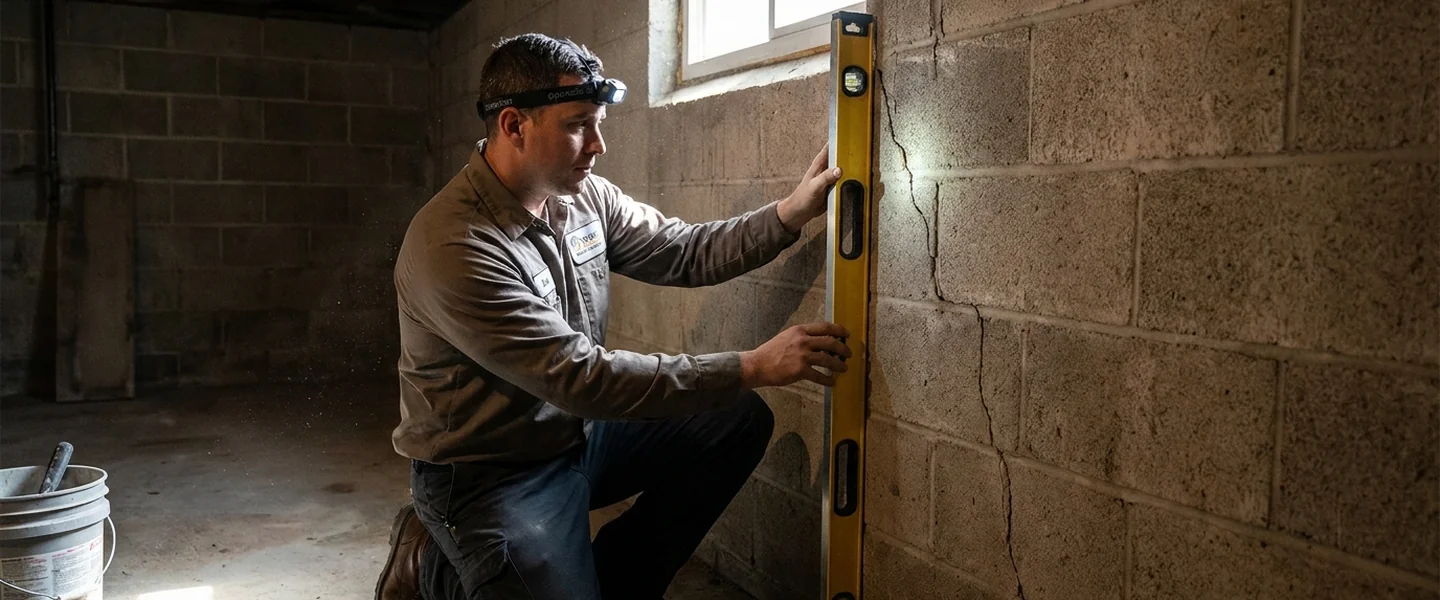
- 1Free inspection and settlement mapping. We measure differential settlement across the slab or foundation perimeter with a laser level. We identify which portions have dropped, by how much, and the probable cause (drainage, tree roots, aging footings, plumbing leaks). The settlement map is included in the written estimate.
- 2Written pier plan. The estimate specifies pier count, pier type (push vs. helical), manufacturer, and exact placement locations along the foundation. No "piers as needed" vague language — you know exactly what you're buying before you sign.
- 3Excavation and utility protection. Access pits are excavated at each pier location. We locate and protect irrigation lines — Fairfax County's established neighborhoods have dense perimeter irrigation systems that we treat as a standard scope item, not an add-on. Utility locates are called in advance.
- 4Pier bracket installation. Steel brackets are attached to the foundation footing at each pier location. The bracket transfers the structural load to the pier.
- 5Pier driving to refusal. Steel pipe sections are hydraulically driven through the bracket into the soil, adding sections until the pier reaches refusal — the point at which the soil below resists further advancement at a load sufficient to support the structure. Refusal confirms the pier has passed through the active clay zone into stable bearing strata.
- 6Simultaneous hydraulic lift. After all piers reach refusal, a hydraulic jack at each pier lifts the foundation simultaneously toward its original elevation. Simultaneous lift distributes stress evenly across the structure, minimizing new cracking. We lift to "practical maximum" — the highest elevation achievable without inducing new cracking in portions of the structure that have adjusted to their settled position.
- 7Excavation restoration. Access pits are filled and graded. Irrigation lines repaired or relocated. The work area is restored to as close to original condition as practical. Concrete spoils removed from the site.
Materials We Use
| Component | Brand / Specification |
|---|---|
| Push Pier System | Earth Contact Products (ECP) Model 350 Steel Push Pier or Chance/Hubbell Atlas Resistance Pier |
| Helical Pier System | Chance/Hubbell SS5 helical pile series or ECP helical pier |
| Pier Brackets | Manufacturer-matched foundation brackets, galvanized steel |
| Pier Material | Grade 80 steel pipe sections, galvanized or epoxy-coated where appropriate |
Common Settlement Scenarios in Fairfax County
Front-of-House Corner Settlement
The most common pattern in Annandale colonials and split-levels — the front two corners of the foundation settle as the front yard dries in summer and the perimeter clay contracts. Stair-step brick cracks and sticking front doors are the early signals. Typically 4–6 piers along the front wall address the pattern.
Single-Corner Tree Settlement
One corner settles significantly more than the others due to a large tree (oak, tulip poplar, maple) drying the clay in a targeted zone. Common in Annandale, Falls Church, and McLean where mature tree canopy is dense. Requires fewer piers but must address drainage to prevent continued root-driven desiccation.
Whole-Perimeter Settlement
The entire foundation perimeter has dropped relative to the interior, common in homes with poor lot grading and downspout discharge against the house. More piers required but also the most responsive to drainage correction as a companion fix.
Addition-to-House Settlement
A family room, sun room, or garage addition settles independently of the original structure. The addition was built on shallower footings or fill soil without the same bearing capacity. The connection joint between addition and house shows the differential — cracks at the seam, doors at the transition not closing properly.
Warranty in Detail
The lifetime manufacturer warranty on push pier hardware covers the pier system maintaining load capacity — the pier does not compress, fracture, or lose bearing. What the warranty does not cover: settlement in un-piered portions of the foundation (only the piered sections are stabilized), new settlement caused by events outside the repair scope (new plumbing leak, grade change, new tree root growth), or cosmetic repairs (crack patching, interior drywall). The warranty is fully transferable to subsequent owners at no charge with written notification. We provide the warranty documentation as a separate signed document at project completion.
How We Quote Piering
Every pier quote requires a physical inspection. We measure settlement across the foundation, identify the active and stable zones, and determine pier count and placement based on what the settlement map shows — not a formula of "one pier per window." Quotes that say "10–14 piers depending on conditions" protect the contractor, not the homeowner. Our quotes say "12 piers, ECP Model 350, at the locations shown on the attached diagram." If conditions on installation day differ from the inspection findings, we call before adding or removing scope.
After Piering — What to Expect
Immediately after installation: the foundation is stabilized at the piered locations. Existing cracks will not close on their own — they require separate repair if cosmetically significant. Some minor new cracking can occur as the structure adjusts to the lift, particularly in plaster walls in older homes (plaster is brittle and responds to any movement). We walk through what to expect before the lift begins. In the 30 days following installation, the restored concrete in excavation pits continues curing — avoid heavy vehicle traffic over the repaired areas. At 12 months, we recommend a courtesy re-inspection to confirm no new settlement has developed in the un-piered zones.
House Leveling & Piering FAQs — Annandale, VA
How many piers does my Annandale home need?
Pier count depends on the length of the settled foundation zone, the structural load at each pier location, and the settlement map we develop at the inspection. A typical Annandale colonial with front-of-house settlement requires 6–12 piers. We specify the exact count in the written estimate — you will not see a range or "as needed" language.
Will piering fix my sticking doors and diagonal cracks?
Piering stabilizes the foundation and may partially restore elevation in settled areas, which can reduce door sticking. Cracks that have been open for years have become structural — the framing has adjusted to the settled position, and cosmetic crack patching is a separate step after piering. We set realistic expectations in writing before the project starts.
How deep do piers go in Fairfax County?
Push piers drive to "refusal" — the depth at which the soil resists further advancement under the driving load. In Fairfax County's Piedmont soils, refusal typically occurs at 15–25 feet below grade, below the active clay zone. We log the refusal depth for each pier as part of the installation documentation.
Is the pier warranty transferable when I sell my home?
Yes — ECP and Chance/Hubbell manufacturer warranties are fully transferable to subsequent owners at no charge with written notification to the manufacturer. The warranty documentation we provide at project completion includes the transfer instructions. A transferable lifetime foundation warranty is a positive disclosure item in a Northern Virginia real estate transaction.
What happens to my landscaping and irrigation?
We excavate access pits at each pier location, typically 18–24 inches in diameter and 3–4 feet deep. We locate and protect or relocate irrigation lines before excavating. After installation, pits are filled, graded, and the area is restored. Plants within the excavation zone may be disturbed — we discuss scope of landscape impact at the inspection, and irrigation repair is included in the project scope.
Should I fix drainage before or after piering?
Both, if possible. Pier installation stops the settlement in the piered zones permanently. Drainage correction reduces the moisture cycling that continues to affect the un-piered zones. We include drainage recommendations in every estimate — downspout extension, lot regrading, or perimeter drainage — so the pier repair isn't fighting an ongoing soil problem.
Annandale-Specific Considerations
Annandale sits in the middle of Fairfax County's most densely settled postwar residential zone — the Columbia Pike, Braddock Road, and Little River Turnpike corridors contain some of the highest concentrations of 1950s–70s slab and basement construction in Northern Virginia. The combination of aging foundation systems, mature tree canopy, and dense clay profiles makes this area one of the most active foundation repair markets in the DC metro region. If you're in the Little River Turnpike, Ravensworth, or Sleepy Hollow neighborhoods, you likely have neighbors who have already addressed the same settlement pattern you're seeing in your own home.
For pre-1970 Annandale homes with original plumbing, we recommend a hydrostatic plumbing test before pier installation. Northern Virginia's cast-iron drain lines corrode from the inside over 50–70 years. An active slab or basement floor leak erodes supporting soil and would continue to undermine the pier repair if not addressed. We do not perform plumbing tests ourselves, but we can recommend licensed plumbers in the Fairfax County area who provide this service.
Free Foundation Inspection in Annandale, VA
Settlement map, written pier plan, lifetime warranty. No same-day pressure. Serving all of Fairfax County.
Call (571) 620-3358Related reading: Foundation Crack Repair | Why Annandale, VA Houses Settle
What You Get in Our Quote vs. the Lowball Bid
We don't compete on the lowest sticker price — we compete on the quote that gets the job actually done. Here is what is included in every quote we write, and the cut-corners that show up in cheaper bids.
Included in our written quote
- Engineer-style elevation + crack assessment
- Soil and drainage evaluation
- Written quote with pier counts + warranty terms
- Photo documentation of every crack/movement
- Permit-pulling where required
- Post-install elevation re-check
Cut corners in the lowball bid
- Free-quote with no actual inspection
- Pier-count guesses without measurements
- Subcontracted installation crews
- Warranties that exclude common failure modes
- Pressure to sign at the kitchen table
- Same-day pricing tricks