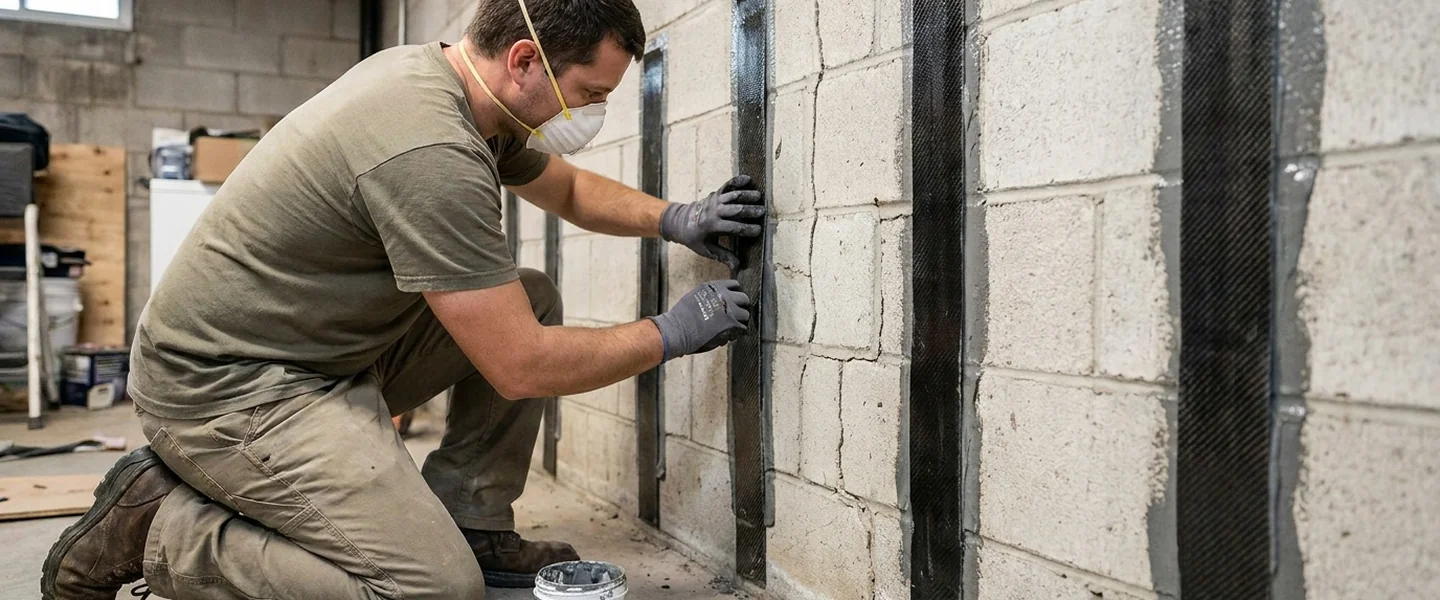
Bowing Wall Stabilization in Annandale, VA
Carbon fiber straps, wall anchors, and steel I-beam systems to stop inward wall movement in Fairfax County basements — before lateral pressure causes structural failure.
Call Now: (571) 620-3358Bowing or leaning basement walls are one of the most serious foundation problems in Northern Virginia's older housing stock. When Fairfax County's dense Piedmont clay becomes saturated after wet winters or heavy rains, it exerts significant lateral pressure against basement walls. Concrete block walls — common in Annandale's 1950s–70s construction — are particularly vulnerable because the mortar joints are weaker than the blocks themselves. Once horizontal cracking begins, the wall is in progressive failure. Annandale VA Foundation Pros installs carbon fiber strap systems, wall anchor systems, and steel I-beam bracing to stop inward movement and stabilize compromised walls. Call (571) 620-3358 for a free assessment.
Why Northern Virginia Basement Walls Bow
The physics are straightforward: soil outside a basement wall exerts horizontal pressure against it. When that soil is saturated Piedmont clay — one of the densest and heaviest soil types in the Mid-Atlantic region — the lateral pressure can exceed the wall's design capacity. Northern Virginia's wet winters, with average precipitation concentrated in December through March, keep the clay saturated for months at a time. Add freeze-thaw cycling from January and February freezes, and the wall faces repeated stress cycles during the highest-pressure season of the year.
Concrete block walls fail before poured concrete because horizontal cracking propagates along the mortar joints — the weakest plane in the wall. A horizontal crack in a block wall means the blocks above the crack are no longer connected to the blocks below except by the wall itself (which is now cracking). The wall above the crack can move inward independently. Once this process starts, it continues with each additional wet season.
Project Details
| Service | Bowing Wall Stabilization (Carbon Fiber, Wall Anchors, or Steel Beams) |
|---|---|
| System Selection | Based on wall material, degree of inward movement, and access conditions |
| Carbon Fiber Straps | Appropriate for walls with minor-to-moderate bowing (<2 inches inward) that have not yet cracked through |
| Wall Anchors | Appropriate for walls with moderate bowing; yard access required for anchor plate installation |
| Steel I-Beams | Used for severe bowing or cracked-through walls requiring rigid bracing; no yard access required |
| Timeline | 1–2 days for most installations |
| Warranty | Lifetime on hardware system; workmanship warranty on installation |
| Pricing | Quoted per job after free on-site assessment — every quote is itemized in writing |
Our Wall Stabilization Process
- 1Free assessment. We measure inward displacement at multiple points on the wall, identify any horizontal cracking, and assess whether the wall is in active movement or has stabilized. We also check exterior drainage conditions that are contributing to the pressure.
- 2System recommendation. Carbon fiber straps, wall anchors, or steel I-beams are selected based on the degree of bowing, wall material, and available access. In some cases a combination is appropriate. The recommendation and technical reasoning are in the written estimate.
- 3Carbon fiber installation (if applicable). Carbon fiber straps are epoxy-bonded vertically to the wall surface, spanning the cracked or bowing zone. The straps are engineered to resist further inward movement without requiring excavation. The wall surface is prepared, straps bonded, and covered with a skim coat for a clean appearance.
- 4Wall anchor installation (if applicable). An anchor plate is installed in the yard soil at a depth below the active pressure zone. A connecting rod passes through the wall to an interior bearing plate. The rod can be periodically tightened over time as soil settles, allowing gradual wall straightening in some cases.
- 5Steel I-beam installation (if applicable). Steel I-beams are set vertically against the wall, anchored to the floor and ceiling framing, and sized to carry the lateral load. Used where the wall has moved too far for carbon fiber and yard access for anchors is unavailable or impractical.
- 6Drainage recommendations. Wall stabilization stops the wall from moving further — it does not reduce the soil pressure causing the movement. Drainage correction (gutters discharging away from the house, lot regrading, or perimeter drainage) reduces the lateral pressure over time and is recommended alongside every stabilization job.
When Horizontal Wall Cracks Are an Emergency
A horizontal crack in a basement or crawlspace wall is the single most urgent foundation warning sign in residential construction. Unlike diagonal settlement cracks that progress gradually over years, a horizontal wall crack means lateral pressure is actively overcoming the wall's structural capacity right now. The question is not whether the wall will fail further without repair — it is how quickly. If you see a horizontal crack in your basement wall, call us the day you notice it. Do not wait for a convenient appointment window.
Signs that a bowing wall situation has crossed into emergency territory: inward displacement visible to the naked eye (a wall that looks visibly off-plumb), a crack wide enough to insert a credit card, or a crack that has grown significantly over weeks rather than months. Call (571) 620-3358 immediately if you see these conditions.
Bowing Wall Stabilization FAQs — Annandale, VA
My basement wall has a horizontal crack. How urgent is this?
Very urgent. Horizontal cracking in a basement wall means lateral soil pressure is exceeding the wall's capacity. The wall is in progressive failure. Call the day you notice it — not after the weekend, not when it's more convenient. Earlier intervention means simpler repair; a wall that has moved 1 inch is much easier to stabilize than one that has moved 3 inches.
Can a bowed wall be straightened, or just stabilized?
Wall anchor systems can be periodically tightened over time, and in some cases gradual straightening occurs as the anchor tension increases and the soil pressure decreases. Carbon fiber straps and steel beams stabilize the wall in its current position — they stop further movement but do not push the wall back. We describe the realistic outcome for your specific wall in the assessment.
How do I know if my wall is actively moving or has stabilized?
Mark the ends of the horizontal crack with pencil marks and dates. Measure the crack width at the same point each month. If the marks are moving and the crack is widening, the wall is active. We also assess this at the inspection using measurements at multiple points on the wall — a wall with more displacement at the center than at the corners has a bowing profile consistent with active lateral pressure.
Does carbon fiber really stop a bowing wall?
Yes — properly installed carbon fiber straps are engineered to resist the lateral loads that cause bowing, with tensile strength significantly exceeding the forces involved. The critical condition is that the wall cannot have moved more than 2 inches inward, and the straps must be bonded to sound concrete or block (not spalling or delaminating). We assess wall condition before recommending carbon fiber.
Will fixing the bowing wall also stop water entry?
Not directly. Wall stabilization stops inward movement — it does not seal the wall against water intrusion. Horizontal cracks that also leak water need waterproofing treatment (epoxy or polyurethane injection, or an interior drainage system to manage the water). We address both in the assessment and can include waterproofing in the same project scope.
Annandale-Specific Considerations
Annandale and Falls Church have some of the highest concentrations of concrete block basement construction in Fairfax County — the 1950s–60s building boom in this area produced thousands of block-wall basement homes in the Braddock, Mason, and Providence District communities. Block walls are structurally more vulnerable to horizontal cracking than poured concrete because the mortar joints are weaker than the units. If your Annandale or Falls Church home was built before 1965 with a full basement, a visual inspection of the basement walls for horizontal cracking should be part of your annual home maintenance checklist — particularly after each winter wet season.
Free Bowing Wall Assessment in Annandale, VA
Horizontal crack? Call today — don't wait. Written repair plan, lifetime warranty system. Fairfax County.
Call (571) 620-3358Related reading: Basement Waterproofing | Foundation Crack Repair
What You Get in Our Quote vs. the Lowball Bid
We don't compete on the lowest sticker price — we compete on the quote that gets the job actually done. Here is what is included in every quote we write, and the cut-corners that show up in cheaper bids.
Included in our written quote
- Engineer-style elevation + crack assessment
- Soil and drainage evaluation
- Written quote with pier counts + warranty terms
- Photo documentation of every crack/movement
- Permit-pulling where required
- Post-install elevation re-check
Cut corners in the lowball bid
- Free-quote with no actual inspection
- Pier-count guesses without measurements
- Subcontracted installation crews
- Warranties that exclude common failure modes
- Pressure to sign at the kitchen table
- Same-day pricing tricks