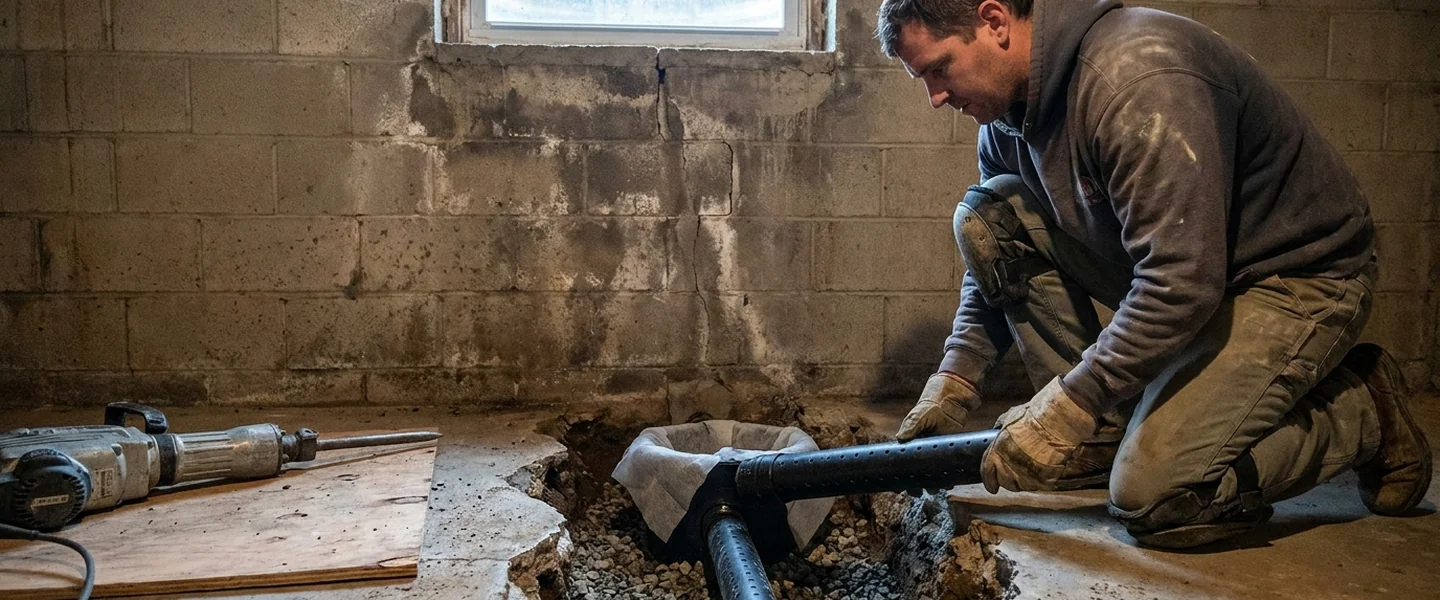
Basement Waterproofing in Annandale, VA
Interior French drain and sump pump systems to stop chronic basement water entry in Fairfax County homes — permanent waterproofing, lifetime transferable warranty.
Call Now: (571) 620-3358Basement water entry is one of the most reported problems in Annandale and Fairfax County's older housing stock — and it's driven by the same dense Piedmont clay that causes foundation settlement. Northern Virginia's wet winters and spring storms saturate the clay around basement walls and floors, building hydrostatic pressure that forces water through floor-wall joints, wall cracks, and porous concrete. Annandale VA Foundation Pros installs interior French drain systems with sump pump discharge to intercept and remove water before it damages living space. Call (571) 620-3358 for a free inspection and written estimate.
Why Northern Virginia Basements Get Wet
Fairfax County's average annual precipitation is approximately 40 inches, with the heaviest loading in the winter and spring months — December through April. The Piedmont clay around basement walls holds this water against the foundation for extended periods because it drains poorly. Unlike sandy soils that drain water away within hours, saturated Piedmont clay can hold standing water against foundation walls for days or weeks after a significant rain event.
The hydrostatic pressure from this standing water finds the weakest paths into the basement: the floor-wall cold joint (where the floor slab meets the wall, a construction gap left by original concrete placement), existing cracks in the wall or floor, tie rod holes from form construction in poured concrete walls, and the porous surface of older concrete block walls. Even walls without visible cracks can transmit water through the block and mortar matrix under sufficient pressure.
Northern Virginia's weather pattern creates a particularly difficult seasonal cycle: January through April rain and snowmelt saturates the clay and pressurizes the basement. Summer brings drought, the clay dries, and the basement dries out. Homeowners who see a dry basement in July sometimes assume the spring water problem has resolved — it hasn't. Next January will bring the same pressure cycle.
Project Details
| Service | Interior French Drain System with Sump Pump |
|---|---|
| Timeline | 1–3 days depending on basement perimeter length |
| Drain Channel | Perimeter channel cut in floor slab at base of wall, drainage tile, gravel bed, concrete restored flush |
| Sump Pit | Excavated below drain level, lined, covered with access lid |
| Sump Pump | Primary submersible pump with battery-backup secondary; discharge to daylight outside foundation perimeter |
| Warranty | Lifetime warranty on drainage system; fully transferable to subsequent owners |
| Pricing | Quoted per job after free on-site inspection — every quote is itemized in writing |
Our Waterproofing Process
- 1Free inspection. We assess water entry points, basement moisture patterns, exterior drainage conditions, and whether wall cracks or bowing walls need separate structural attention alongside waterproofing.
- 2Written quote. Linear footage of drain channel, sump pit location, pump specifications, discharge routing, and warranty terms itemized before work begins.
- 3Floor perimeter channel. We jackhammer a channel at the interior base of the basement wall, just inside the footing. The channel is excavated below the footing level to intercept water that enters at the floor-wall joint.
- 4Drainage tile installation. Perforated tile laid in a gravel bed in the channel, sloped toward the sump pit. Water entering through the wall base or floor joint flows into the tile and routes to the sump.
- 5Sump pit and pump. Pit excavated at the collection point, lined, and primary submersible pump installed. Battery backup pump set above primary. Discharge line run through the wall to daylight outside the perimeter.
- 6Concrete restoration. Channel filled with new concrete flush with existing floor. Sump pit covered with access lid. Finished product is a clean floor with only the sump cover visible.
Interior vs. Exterior Waterproofing
Exterior waterproofing — excavating to the footing, applying membrane, and installing exterior drainage — is the most comprehensive solution but requires full perimeter excavation, which disrupts mature landscaping, hardscaping, and utility lines extensively in Annandale's established neighborhoods. For most existing Fairfax County homes, interior French drain with sump pump is equally effective at keeping the basement dry at a significantly lower disruption and cost level. Exterior waterproofing is most appropriate for new construction or homes where the wall itself requires exterior membrane repair. We recommend the appropriate system at the inspection.
Warranty in Detail
Our lifetime warranty covers the drainage channel and tile remaining free-flowing and functional. The drainage system itself — not the sump pump — carries the lifetime warranty, because pumps have mechanical service lives of 7–10 years. The warranty does not cover: sump pump mechanical failure (pumps need periodic replacement, which we service separately), water entry through untreated entry points not included in the original scope, or damage from events outside our scope. Fully transferable to subsequent owners with written documentation.
How We Quote Waterproofing
Waterproofing quotes require a physical inspection because scope depends on how much of the basement perimeter has active water entry, whether the wall has structural issues that need separate attention, the existing sump pit condition, and exterior drainage. A phone quote without seeing the basement is a ballpark estimate that will change on installation day. We inspect, assess all entry points, and provide a written itemized quote — linear footage of channel, pit count, pump model, discharge routing — before any commitment.
After Waterproofing Installation
Concrete restoration requires 48–72 hours of cure before foot traffic or light loads. The sump pump is operational immediately. We test both primary and backup before leaving and walk through operation. Annual maintenance: test the battery backup by pouring water into the pit until it activates — confirm it moves water and the battery alarm is silent. Battery replacement every 3–5 years. Primary pump replacement at 7–10 years; we service and replace as a maintenance call.
Basement Waterproofing FAQs — Annandale, VA
My basement only gets wet in spring. Is that normal — do I still need waterproofing?
Spring water entry in Fairfax County basements is a predictable annual pattern, not a one-time event. The wet season cycle — winter/spring saturation followed by summer dry-out — will repeat every year without a drainage system. If the water is causing damage to finishes, mold risk, or limiting how you use the space, a permanent drainage system is the appropriate solution. "Only in spring" doesn't mean "will stop on its own."
Why does my basement smell musty even when it looks dry?
Moisture that evaporates from concrete and block walls raises humidity in the basement air even without visible water. Persistently high humidity in a Fairfax County basement during spring and fall leads to mold growth in wall cavities, under carpet, and behind finished walls — often before visible water appears. A drainage system that actively removes water reduces baseline humidity and eliminates the moisture source driving the mold risk.
Do I need a battery backup sump pump in Northern Virginia?
Yes. The winter storms and nor'easters that generate the most water against Fairfax County basement walls frequently knock out grid power. A battery backup pump operates during outages — exactly when protection is most needed. We include battery backup as standard on every installation.
Will waterproofing also fix my bowing wall?
No — waterproofing and wall stabilization address different problems. Waterproofing intercepts and removes water. A bowing wall requires structural stabilization (carbon fiber straps, wall anchors, or steel beams) to stop inward movement. If your wall is both leaking and bowing, we address both in the same project scope — structural stabilization first, then waterproofing.
How much does basement waterproofing cost in Annandale, VA?
Call (571) 620-3358 for a free written estimate. Cost scales with linear footage of drain channel required, sump pit count, and whether any wall crack treatment is included in the scope.
Annandale-Specific Waterproofing Considerations
Fairfax County's winter and spring wet season is the highest-risk period for basement water entry. January through April brings rain, snowmelt, and freeze-thaw cycles that keep the Piedmont clay saturated against basement walls for months at a time. Annandale homeowners who have experienced one spring water event should expect the same pattern to repeat annually until a drainage system is installed.
The older concrete block basement walls common in Annandale's 1950s–60s housing stock are more permeable to water than poured concrete walls. Block walls transmit moisture through the block matrix and mortar joints even without visible cracks. Interior drainage is effective regardless of wall type — it intercepts water that enters at the floor-wall joint rather than trying to stop water at the wall surface.
Free Basement Waterproofing Inspection in Annandale, VA
Written estimate, lifetime warranty on the drainage system, locally owned. Same-week appointments across Fairfax County.
Call (571) 620-3358Related reading: Sump Pump Installation | Bowing Wall Stabilization
What You Get in Our Quote vs. the Lowball Bid
We don't compete on the lowest sticker price — we compete on the quote that gets the job actually done. Here is what is included in every quote we write, and the cut-corners that show up in cheaper bids.
Included in our written quote
- Engineer-style elevation + crack assessment
- Soil and drainage evaluation
- Written quote with pier counts + warranty terms
- Photo documentation of every crack/movement
- Permit-pulling where required
- Post-install elevation re-check
Cut corners in the lowball bid
- Free-quote with no actual inspection
- Pier-count guesses without measurements
- Subcontracted installation crews
- Warranties that exclude common failure modes
- Pressure to sign at the kitchen table
- Same-day pricing tricks